Headaches arise from the pain-sensitive structures of the head. Numerous stimuli are capable of eliciting painful signals and are broadly grouped as mechanical, thermal or chemical.
Most headaches occur as a result of mechanical traction, compression or the chemical irritation of the following pain sensitive structures:
Scalp - skin, subcutaneous tissue andperiosteum of the skull
Joints - cervical (neck) and jaw joints
Muscles - scalp and paraspinal muscles
Sinuses
Teeth
Ocular contents
Blood Vessels - arteries, veins and venous sinuses
Meninges - linings within the brain
Cranial Nerves
The International Headache Classification considers:
These are not associated with any underlying disease. While there are others, the main primary headaches are:
1. Migraine
2. Tension Type Headaches
3. Trigeminal Autonomic Cephalagia. Including: Cluster Headaches, SUNCT, SUNA, Paroxymal Hemicrania
Where there is underlying disease causing the pain. Causes can be:
1. Infectious
2. Neoplastic
3. Vasculariv. Drug induced (including Medication Overuse Headaches)
Further: Chronic headache is defined as occurring 15 days or more per month and have occurred for at least 3 months.
A good history is the key to diagnosis. Examination is usually normal in patients with primary headache, such as migraine, tension-type headache, and cluster headache.
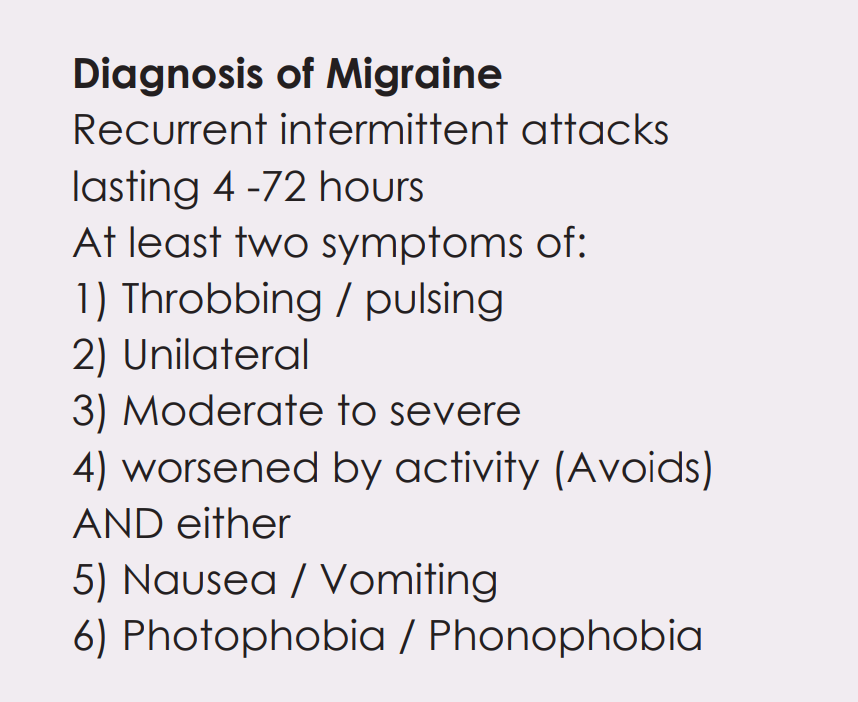
Recurrent severe disabling headaches
Associated with nausea and sensitivity to light
Normal neurological examination
Characteristically unilateral, pulsating
Builds up over minutes to hours
Aggravated by routine physical activity
It is the most common type of severe primary headache
More than half of women with migraine report an increased frequency and severity of migraine attacks around menstruation
Recurrent, non-disabling headache
Bilateral
Normal neurological examination
Tension-type headache is less burdensome than migraine to the individual patient but is of higher prevalence
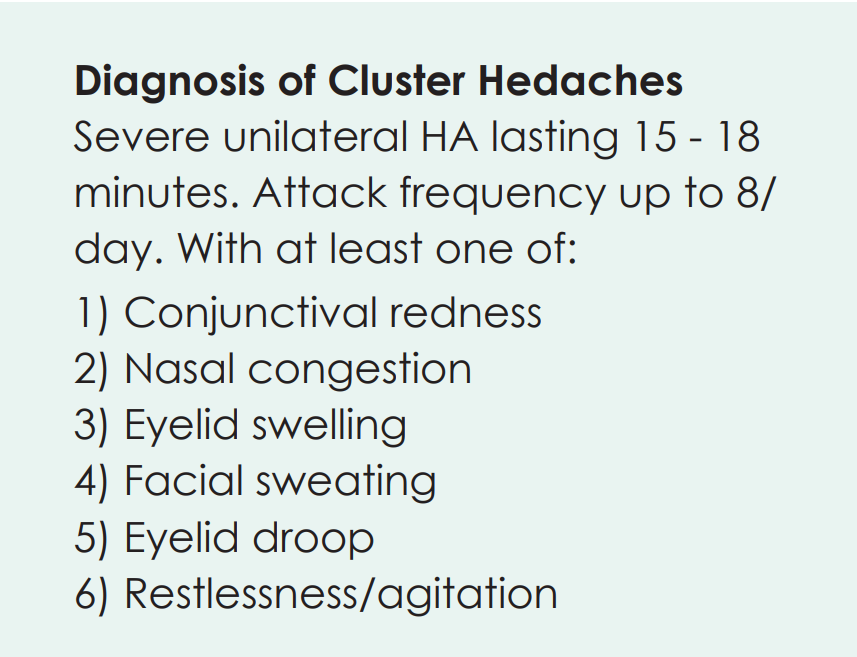
The most common form is ‘Cluster Headache’. SUNCT, SUNA and Paroxymal Hemicrania are similar but the duration of attacks vary. Frequent, brief, unilateral headaches with facial sensations (such as tearing, eye redness, facial sweating) on the same side to the headache. These headaches are rare but excruciatingly severe.
This is NOT a diagnosis but implies the headache occurs frequently.

Secondary Headaches
Secondary headaches should be considered in patients with NEW onset headaches or headaches which differ from their usual headaches. ‘RED FLAG’ features should be considered. The mnemonic SNOOP T helps.
S Systemic Symptoms or Secondary Risk Factors
FEVER, WEIGHT LOSS, KNOWN CANCER, HIV, IMMUNOSUPPRESSION, PATIENTS WITH RISK FACTORS FOR CEREBRAL THROMBOSIS, JAW CLAUDICATION, VISUAL DISTURBANCE
N Neurological Symptoms or Abnormal Neurological Signs:
CONFUSION, IMPAIRED ALERTNESS, DROWSINESS, LIMB WEAKNESS, COGNITIVE DISTURBANCES
Optometry Based Signs : Neurological Screen, Fundoscopy, Pupils, Colour Perception, Ocular motility.
O Onset
‘FIRST AND WORST HEADACHE’, THUNDERCLAP HEADACHE, SUDDEN OR ABRUPT AWAKENING FROM SLEEP (but remember that migraine is the most frequent cause of morning Headaches) PROGRESSIVELY WORSENING. NEW ONSET HEADACHES IN PATIENTS OVER 50, PATIENTS WITH KNOWN CANCER, PATIENTS WITH HIV.
O Older
NEW ONSET OR PROGRESSIVE IN OVER 50s. (Temporal Arteritis could also be associated with jaw claudication and temporal tenderness)
P Previous Headache History
FIRST HEADACHE OR FUNDAMENTALLY DIFFERENT FROM EXISTING HEADACHES (Significant change in features, frequency, severity, associated symptoms)
T Triggered Headaches
HEADACHE PRECIPITATED BY PHYSICAL EXERTION OR VALSALVA ACTIVITIES (coughing, straining, sneezing) HEADACHE CHANGING WITH POSTURE
1) New headache in a patient aged over 50 consider Temporal Arteritis
2) First presentation of thunderclap onset. Refer immediately to hospital for exclusion of subarachnoid haemorrhage, intracranial haemorrhage, meningitis, cerebral thrombosis.
3) For patients with headache and features suggestive of infection of the central nervous system (such as fever, rash), refer immediately to hospital.
4) Headache with features suggestive of raised intracranial pressure: changing with posture; valsalva headache (triggered by coughing, sneezing, bending, heavy lifting, straining); Fever; History of HIV or cancer; Focal or non-focal symptoms or signs; papilloedema. Refer urgently.
5) Consider MRI for patients presenting with a trigeminal autonomic cephalalgia.
6) Consider intracranial hypotension in all patients with headache developing or worsening after assuming an upright posture. Refer such patients to a neurologist or headache clinic. Secondary Headaches