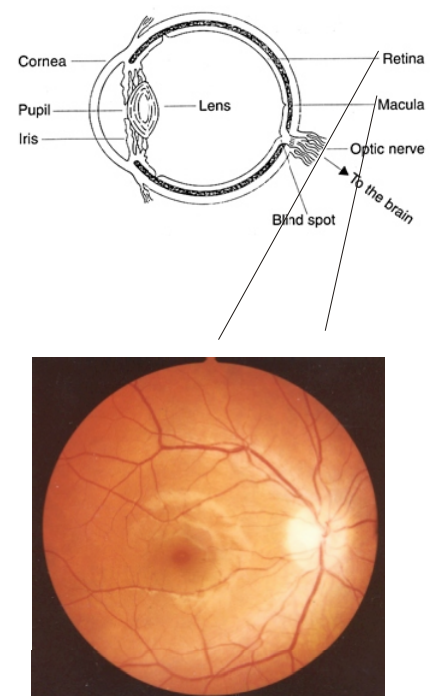
Age Related Macula Degeneration (AMD) accounts for more cases of registerable sight loss than any other eye disease. Macula Degeneration (AMD) only affects the central retina (called the macula), the peripheral retina is undamaged. Two forms of this degenerative disorder exist, ‘Wet’ and ‘Dry’.
The ‘Dry’ form is most common. The macula looks flat and shows pale areas called Drusen; also darker pigmented areas may be evident. While there is no treatment for ‘Dry’ AMD it is generally quite slow in progression and has afar less marked affect on vision. Unfortunately, it is possible for ‘Dry’ AMD to transform into ‘Wet’.
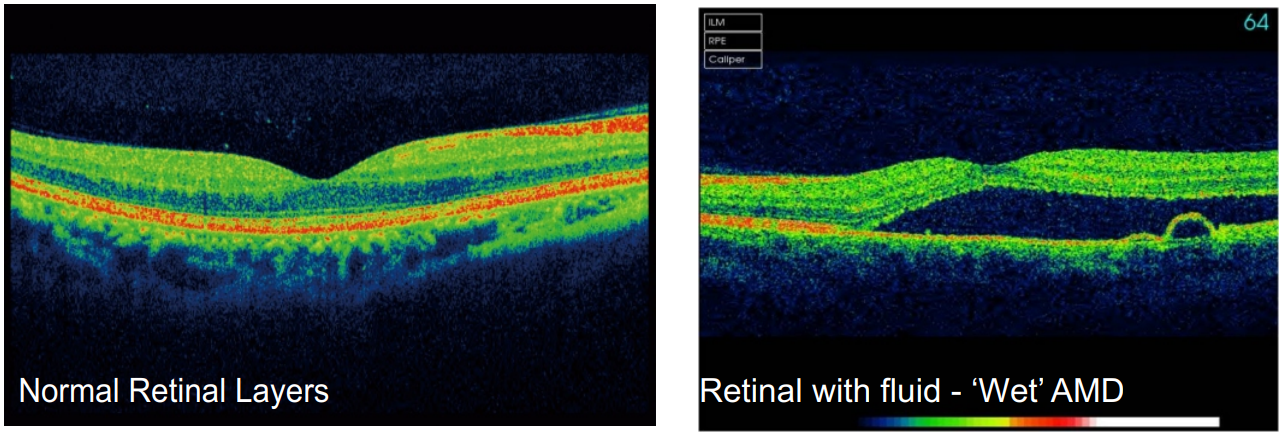
The ‘Wet’ form causes severe and rapid loss of vison. With ‘Wet’ AMD, new blood vessels grow beneath the retina and leak blood and fluid.
The treatments for ‘Wet’ AMD are improving constantly. The first big breakthrough was Photo Dynamic Therapy (PDT). This treatment did not improve vision but attempted to stop the condition progressing. Now the mainstay of treatment is injections with Anti-VEGF drugs. These drugs, such as Lucentis, can actually improve vision.
It is vital than ever to be able to detect ‘Wet’ AMD as early as possible to access help rapidly. We have invested in advanced scanning technologies, and the higher qualifications of our Medical Optometrists, allow accurate interpretation.
For patients who have suspect ‘Wet’ AMD there is a fast track mechanism for referral. Patients can be seen in the Eye Hospital within two weeks. It is therefore vital to know the symptoms and be able to detect very subtle signs in the community.
Distortion of vision is a vital sign. We often give patients an Amsler Chart to use at home to monitor any sudden changes. Rapid reduction in vision, seen as a blurring, is also important.
Historically Volk Fundoscopy was the mainstay of detection. Very early signs however are often very difficult to detect as the damage is beneath the retinal surface. Likewise retinal photography only lets us see the surface and not what is happening beneath it! Our Scanning tomographer lets us see into the retina allowing us to detect the earliest signs of intra-retinal fluid; allowing prompt detection and referral.
As vital as this technology is, the NHS does not provide funding.However, regardless of funding constraints, our role is to ensureyou have all available choices; a Medical Upgrade isrecommended.