Varifocals
Not All Varifocals Are The Same!
Written by:
Dr Peter Frampton
Completed:
April 27, 2026

As an independent we are not restricted to any marketing policies and can supply any lens we feel will benefit our patients. We are happy to have added Zeiss lenses to our portfolio to augment Nikon, Shamir, Essilor, Rodenstock and Hoya.
Most general-purpose, let’s call them ‘everyday’, varifocal lenses have the distance vision section at eye level, with a corridor, down and in, of increasing power toward the near section. The ‘blending’ of power creates areas of distortion either side of the corridor. A primary problem with lower quality varifocal lenses is the high level of distortion created by the isocylinder lines in the lens periphery. All varifocals will have some form of distortion, just how much, is down to the lens choice. It has been reported in the optical press a proportion of patients failing with varifocalsdo so because they have been dispensed a poor-quality lens form with significantedge distortion. Value is not only associated with price.

As professionals it is vital we inform and educate patients on the range of varifocal types, including both positive and negative aspects of each. A professional handover from the optometrist, or a brief case history for outside dispenses, is essential. This process allows us to get to know our patients and understand their unique lifestyle needs. Only after this critical process can a meaningful discussion on specific lens types to best manage those requirements be considered. This ensures each person can make an informed choice.
We often describe general-purpose, ‘everyday’, varifocals as 95% glasses. They work very well for most daily tasks such as looking at a watch or mobile phone or reading while watching TV. However, there are tasks, especially in a modern office or home-based world, for which they are less adequate. Desktop computers are the prime example. Spending protracted periods at a desktop with ‘everyday’ varifocals will entail tilting your head to bring the ‘near vision’ section into play. A thorough case history should identify if this is a potential problem for the individual. In this scenario other ‘progressive’ lens forms may be more suitable. ‘Degressive’ lenses (aptly described by our colleague, Ann, as ‘Inside Varifocals) can be beneficial. Many people, working from home or office do not really need perfect distance vision but rather more ‘intermediate to near’ vision. A range of options from pure ‘Desktop/Near’ progressives to ‘4 metres and closer’ can be great for a significant number of office workers.
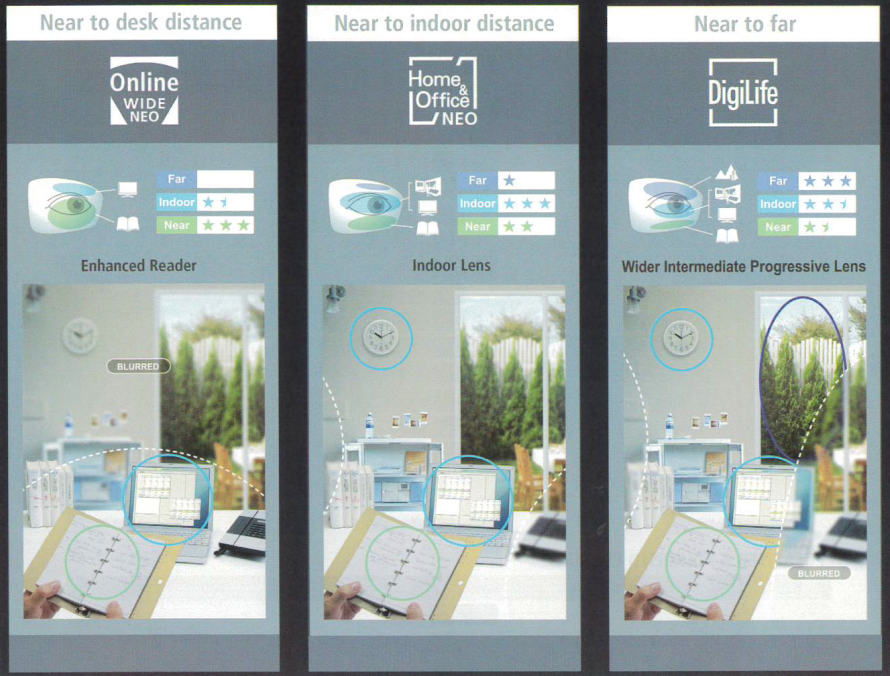
It is more meaningful to find out your needs and expectations first. Only then can the professional dispenser be able to suggest the best progressive lenses to suit those needs, being mindful of possible negatives. Fitting you to a generic lens makes, at least to us, little sense.



.jpeg)

